| Signal Analysis | DVB-T, DVB-H, and DVB-T2 (Version 1.1.1, 1.2.1, and 1.3.1) standards; DVB-T2 option supports Mode A (single PLP) and Mode B (multi-PLP), SISO and MISO, and DVB-T2-Lite measurements
Transmitter, modulator, gap-filler or SFN network RF measurement, analog baseband measurements with PXA BBIQ or MXA BBIQ hardware
One-button measurements with pass/fail per the standard, plus auto detection
Runs inside PXA, MXA, and EXA signal analyzers
|
| Measurements | Power measurement: channel power, shoulder attenuation, ACP, CCDF, spurious emission, SEM
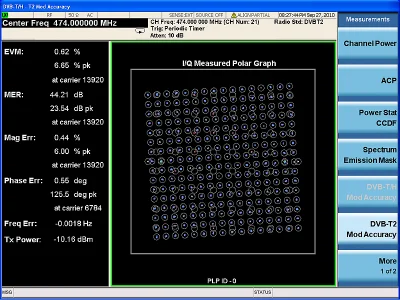
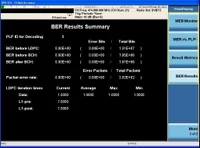
Modulation accuracy measurement: constellation, TPS decoding (DVB-T), L1-signaling (DVB-T2), MER/EVM (MER RMS/peak, MER by subcarriers, MER by data, and pilot), BER, frequency error, amplitude error, phase error, phase jitter, quadrature error, amplitude imbalance, carrier suppression, MER monitoring
Channel frequency response and channel impulse response (supports SFN test for pre-, post-, 0 dB, and out-of-GI range echo scenarios)
Auto-detection or manual settings of the DVB-T, DVB-H, DVB-T2, or DVB-T2-Lite signal; provides advanced settings such as equalization switch, payload type, demodulation symbols, out-of-band filtering, clock rate, and BER count
|
| Performance (Hardware Dependent) | Power accuracy: up to ±0.19 dB (95th percentile)
Shoulder attenuation dynamic range: up to 97.8 dB (102.8 dB typical)
MER floor: up to 50 dB (2K mode and 64QAM with EQ off for DVB-T); up to 51 dB (32K mode, 256 QAM, Constellation rotation Yes with EQ Off for DVB-T2)
Analysis bandwidth: PXA/MXA up to 160 MHz; EXA up to 40 MHz (Options PC4 and DP2 are recommended to improve DVB-T2 modulation accuracy measurement speed)
|